Where to Find Free Stock Photos That Actually Look Like Real People

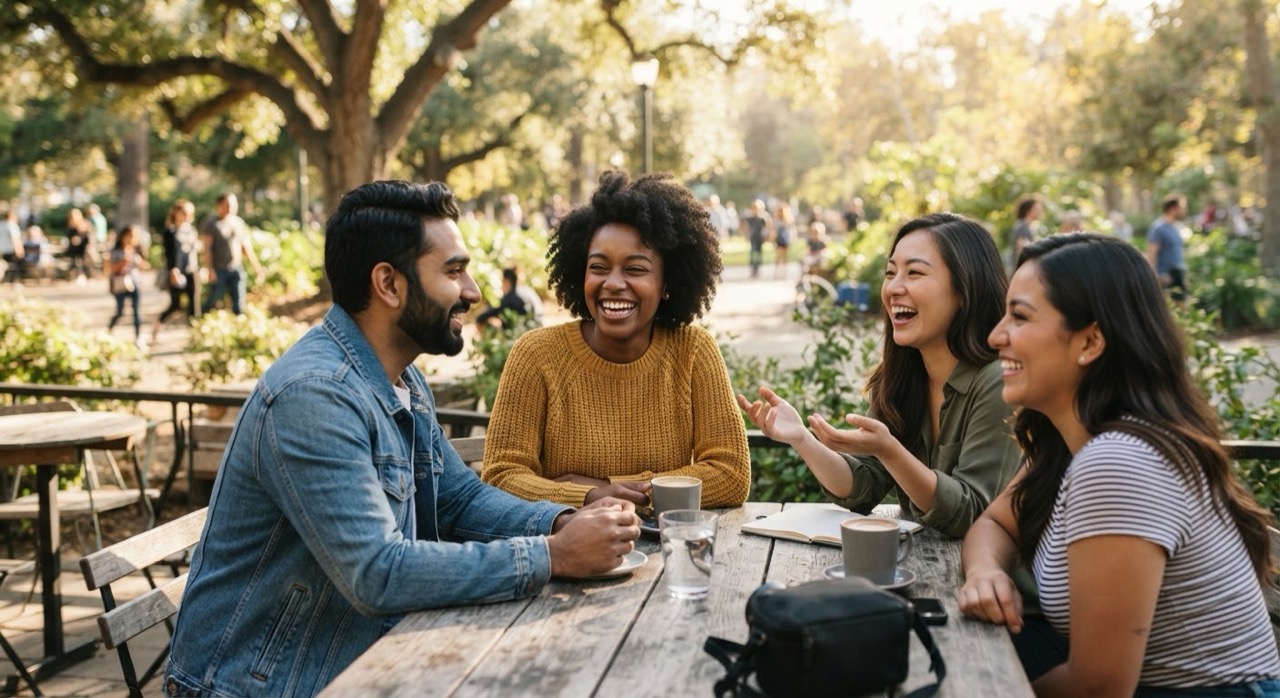
Here is the test. Put your homepage next to your competitor’s. If you could swap the photographs between them and nobody would notice, the photographs are not doing any work. Generic stock people are the fastest way to fail that test — the perfectly-lit team of five, one of each demographic, applauding at a laptop.
The problem is not that free libraries lack photos of people. It is that they are optimized for the keywords marketers type, and marketers type “business team.” So you get business teams. Finding people who look like they have jobs, bodies, and bad days means knowing where else to look.
Libraries built specifically for this problem
A handful of projects exist precisely because mainstream stock was failing on representation. They are small, which is the point — every image was chosen by someone.
- Nappy — free photos of Black and Brown people, and the best-known of the bunch. Genuinely useful range: not just portraits, but people cooking, working, parenting, resting.
- The Jopwell Collection — Black, Latinx, and Native American professionals, from the career platform Jopwell. Skews toward workplace and campus scenes, which is exactly the category mainstream stock does worst.
- Disabled And Here — disabled Black, Indigenous, and people of color, shot in the Pacific Northwest. Released under a Creative Commons Attribution license, so credit is required — check the terms rather than assuming.
- The Gender Spectrum Collection — trans and non-binary models, published by Vice. Note the license carefully: it is intended for editorial use, not advertising. Do not put these in an ad campaign.
- #WOCinTech Chat — women of color in tech, hosted on Flickr under a Creative Commons license requiring attribution. The set is not new, and it shows in the hardware on the desks.
Two cautions. First, licenses vary widely across these projects and several are not the no-attribution style you may be used to from the big libraries — read each one. Second, these collections are small enough that overuse is a real risk. If you have seen a Nappy photo on three SaaS sites this year, so has your audience. Treat them as a source, not a shortcut, and pair them with the license check you would do anywhere else.
Searching the big libraries better
Unsplash, Pexels, and Pixabay do hold photos of real-looking people. Their search just does not surface them by default. Some things that reliably help:
Search the verb, not the job title
“Entrepreneur” returns a costume. “Unloading a van” returns a person. Describe the action and the environment — “kitchen prep”, “sanding wood”, “waiting at a bus stop” — and the results shift from casting to documentary almost immediately.
Add a constraint that models never have
Try adding a specific, unglamorous noun: a hi-vis vest, a folding chair, a laundromat, a hospital corridor. Stock shoots do not build sets around folding chairs. Photographers who were actually somewhere do.
Search in another language
Most of these libraries index contributor titles and tags. Searching a term in Portuguese, Indonesian, or Polish pulls up photos uploaded by photographers working in those places, shot for their own reasons, and largely unseen by English-language marketers.
Follow the photographer, not the keyword
The single highest-leverage move. When one image lands, open the contributor’s profile. Someone who photographed one honest portrait in a workshop shot the whole workshop that afternoon. A profile gives you a consistent look across a whole page — which a keyword search never will.
The releases question you cannot skip
Free libraries license the photographer’s copyright. They do not license the face. None of the major free platforms guarantees a signed model release exists, and their own terms tell you not to use identifiable people in ways that suggest endorsement or that a reasonable person would find offensive.
Editorial and illustrative use of a stranger’s face is generally low-risk. Putting that face in an advertisement, next to a health claim, or beside a political message is a different category of decision entirely.
If the image is going into paid media, a product package, or anything implying the person uses your product, get a licensed image with a release or commission a shoot. This is one of the few places where “it was free” is an expensive answer.
Or stop using stock people
The most under-considered option: don’t. Photograph your own team badly and honestly — a real desk, a real whiteboard, a phone camera and window light. It will outperform polished stock on trust every time, and it solves the release problem, the overuse problem, and the sameness problem in one move. Free libraries are excellent for texture, place, and object photography. For faces, they are a compromise, and it is worth knowing it is one before you build a page around them.